Top Microsoft Dynamics 365 Partners in Saudi Arabia: A 2026 Buyer's Guide
Find the top Microsoft Dynamics 365 Business Central partners in Saudi Arabia. Compare KSA-active firms by ZATCA compliance, localization, and delivery track record.

AI-generated header image for: Top Microsoft Dynamics 365 Partners in Saudi Arabia: A 2026 Buyer's Guide
Choosing the right technology partner can determine whether your digital transformation succeeds or stalls entirely. For businesses operating in Saudi Arabia, where Vision 2030 is accelerating enterprise modernization at an unprecedented pace, selecting the right Microsoft Dynamics 365 implementation partner is one of the most consequential decisions you will make this year.
The market is crowded. Dozens of firms claim expertise, but only a handful consistently deliver measurable results across ERP, CRM, and cloud migration projects. That is exactly why this guide exists.
Whether you are evaluating partners for the first time or reconsidering your current vendor, this buyer's guide cuts through the noise. We have researched and ranked the top Microsoft Partner in Saudi Arabia based on verified certifications, industry specializations, client portfolio depth, and local support capabilities.
By the end of this listicle, you will have a clear picture of which partners bring genuine technical authority to the table, what differentiates them from the competition, and how to align your specific business requirements with the right Dynamics 365 specialist for 2026 and beyond.
What Actually Makes a Microsoft Partner Top-Tier in Saudi Arabia
Not all Microsoft partners operating in Saudi Arabia are built the same, and the gap between a credentialled partner and a capable one can cost your business months of delays, compliance failures, and costly rework. Evaluating partners on the right criteria is the single most important step before signing any implementation agreement.
Award designations are unreliable proxies for delivery quality. "Partner of the Year" badges reflect marketing investment and Microsoft relationship management, not whether a partner can sequence a clean implementation or reduce your process complexity. What matters is measurable outcomes: reduction in manual steps, post-go-live support responsiveness, and whether the system was delivered on scope and on time. Ask for verifiable client references, not certificate screenshots.
ZATCA Phase 2 compliance is a hard requirement, not a roadmap item. As of 2026, the Zakat, Tax and Customs Authority can reject invoices in seconds via direct API integration with the FATOORA portal. A credible KSA partner must demonstrate active, tested Business Central capability covering UBL 2.1 XML formatting, cryptographic stamps, UUID sequencing, and real-time clearance for B2B invoices. Any partner offering a future promise on ZATCA readiness should be disqualified immediately.
Arabic localization is a market-specific test that global generalists routinely fail. This goes beyond translation. It includes Arabic-language ERP interfaces, Hijri calendar support, 15% VAT configuration, and local payroll and HR compliance. Generic partners rarely prioritise these configurations, and gaps surface at the worst possible moment during go-live.
Microsoft's 2026 Release Wave 1 embeds agentic AI and Copilot-driven workflows directly into Business Central. A top partner must be able to configure and activate these features in your environment, not simply hold a subscription license. Power Platform automation and Customer Insights data unification have also shifted from premium add-ons to baseline delivery expectations for any certified Dynamics 365 partner in 2026.
Finally, local presence is an operational predictor, not a preference. According to this implementation guide for Saudi and UAE deployments, choosing a partner without in-Kingdom expertise is the single most avoidable risk in any regional technology project. Arabic-speaking consultants, in-Kingdom client references, and support hours aligned to KSA business operations directly determine communication clarity and response speed during critical project phases. You can review how leading partners position these capabilities in resources like this overview of Microsoft Dynamics 365 partners in Saudi Arabia to benchmark your own evaluation criteria.
The KSA Microsoft Dynamics 365 Partner Landscape
The Microsoft Dynamics 365 partner ecosystem in Saudi Arabia spans a wide range of firm types, sizes, and specializations. Understanding where each partner sits within that spectrum is essential before committing to an RFP or vendor shortlist.
Index of Solutions: Specialized Business Central Partner for KSA
Index of Solutions operates as a dedicated Microsoft Dynamics 365 Business Central consultancy with active implementations across the KSA and broader Middle East markets. The firm covers retail, trading, manufacturing, and fashion verticals, delivering the complete implementation lifecycle from initial business process analysis through go-live, post-launch customization, system integration, and long-term support. This end-to-end ownership model matters in practice because the partner who designed your workflows is also the partner maintaining them, which reduces the handoff risk that derails many ERP deployments after go-live.
A notable differentiator within Index of Solutions' capability set is its LS Central retail ERP practice. LS Central is a specialized vertical solution built on the Business Central platform, and competency in it is not interchangeable with general Business Central experience. Retail-specific requirements such as point-of-sale integration, inventory replenishment logic, and loyalty program management require dedicated practice depth that generalist partners simply do not carry. For KSA retailers evaluating Business Central, this specialization is a meaningful qualifier, not a marketing distinction.
On the compliance and localization front, Index of Solutions bundles ZATCA e-invoicing compliance, Arabic localization, and Power Platform integration as standard service components rather than premium add-ons. This is a relevant structural point for KSA buyers: Business Central does not include ZATCA Phase 2 compliance in its core global product. Compliance is delivered through a localization extension, meaning your ongoing regulatory standing depends directly on your partner's update discipline and release cycle. Working with a partner that treats ZATCA as a core competency, not an afterthought, reduces that compliance exposure materially. The firm's Arabic-speaking consulting team further positions it for the KSA mid-market and SME tier, where bilingual delivery directly affects adoption quality and user training outcomes.
Trax Group: Broad-Scope Regional Microsoft Partner
Trax Group is an active KSA-based Microsoft Dynamics 365 partner as of 2026, covering Business Central, Finance and Operations, Customer Engagement, and the Power Platform under a unified portfolio. Its industry focus spans retail, manufacturing, distribution, and financial services, making it a viable option for organizations that anticipate needing multiple Dynamics 365 modules under a single partner relationship.
Global Enterprise Partners and the SME Gap
Global system integrators including Avanade, DXC Technology, Hitachi Solutions, KPMG, and PwC handle large-scale, multi-country Microsoft deployments at the enterprise tier. Their engagement models and cost structures are calibrated for organizations with complex, multi-entity requirements and budgets to match. For KSA SME and mid-market organizations, these firms represent an effectively inaccessible tier, and this is not a criticism but a structural reality. The gap they leave is precisely where regional specialists operate with greater relevance and commercial fit.
How to Evaluate Any Partner on This List
Regardless of which partner you shortlist, three evaluation steps should precede any RFP submission. First, request Saudi-specific client references with verifiable outcomes, not generic testimonials. Second, ask for a methodology walkthrough that covers how the partner handles ZATCA e-invoicing requirements and Arabic localization within their standard delivery framework. Third, verify that the partner's ZATCA compliance extension is actively maintained and aligned with the current FATOORA portal requirements. These three checkpoints will surface capability gaps faster than any award designation or search ranking.
Why Business Central Over SAP or NetSuite for Saudi SMEs
For Saudi SMEs evaluating ERP platforms, the choice between Business Central, SAP, and NetSuite comes down to three practical realities: cost structure, regional compliance depth, and ecosystem fit.
SAP ERP and SAP S/4HANA collectively dominate the global enterprise tier at 10.83% and 10.58% market share respectively, but that dominance comes with a price point that structurally excludes most Saudi growth-stage businesses. SAP S/4HANA implementations typically start at $500K annually in licensing alone, before factoring in the multi-year deployment timelines, specialized consultant requirements, and deep customization overhead that enterprise SAP projects demand. For a Saudi SME operating in retail, trading, or manufacturing, this cost-to-value ratio simply does not work. Business Central targets businesses in the $10M to $500M revenue range with Essentials licensing at $70 per user per month and Premium at $100 per user per month, delivering enterprise-grade functionality at a fraction of the entry cost.
NetSuite competes meaningfully in the global mid-market at 5.22% ERP share, but its KSA-specific weaknesses are material. ZATCA Phase 2 e-invoicing compliance, now mandatory for all Saudi taxpayers, requires third-party add-ons for NetSuite deployments rather than being natively embedded. Arabic localization carries similar dependency. NetSuite also runs 30 to 50% more expensive than Business Central for equivalent user coverage, a gap that is difficult to justify when the core compliance and localization advantages belong to the competing platform. According to a detailed 2026 comparison of Business Central vs SAP vs NetSuite, NetSuite's strongest use cases center on multi-subsidiary consolidation and pre-IPO financial readiness, capabilities that are largely irrelevant to the majority of Saudi SME operating structures.
For organizations already running Microsoft 365, Teams, Outlook, Azure, and Power BI, Business Central operates as a native platform extension rather than a separate software purchase. Copilot AI is included in standard licensing with no additional billing, while competing platforms treat AI and advanced analytics as separately priced features. This integration efficiency is a direct operational advantage, not a marketing point.
The broader platform story reinforces the investment case. The full Microsoft Dynamics suite leads the global ERP category at 24.41% combined market share, signaling sustained R&D investment, long-term vendor stability, and a deep global partner ecosystem. As 2026 market data confirms, this scale provides Saudi buyers with confidence in upgrade continuity and support availability over a 5 to 10 year horizon.
Saudi Arabia's Vision 2030 agenda adds a further structural dimension. With 1.5 million SMEs contributing 35% to non-oil GDP and 55% of Saudi businesses actively planning cloud adoption, the demand for affordable, compliant, cloud-native ERP is not a future consideration; it is a present requirement. Cloud ERP adoption trends in the Saudi SME sector reinforce that Business Central's subscription model, ZATCA-native compliance, and Microsoft alignment position it as the most practical platform for Vision 2030-stage digital transformation at the SME and mid-market tier.
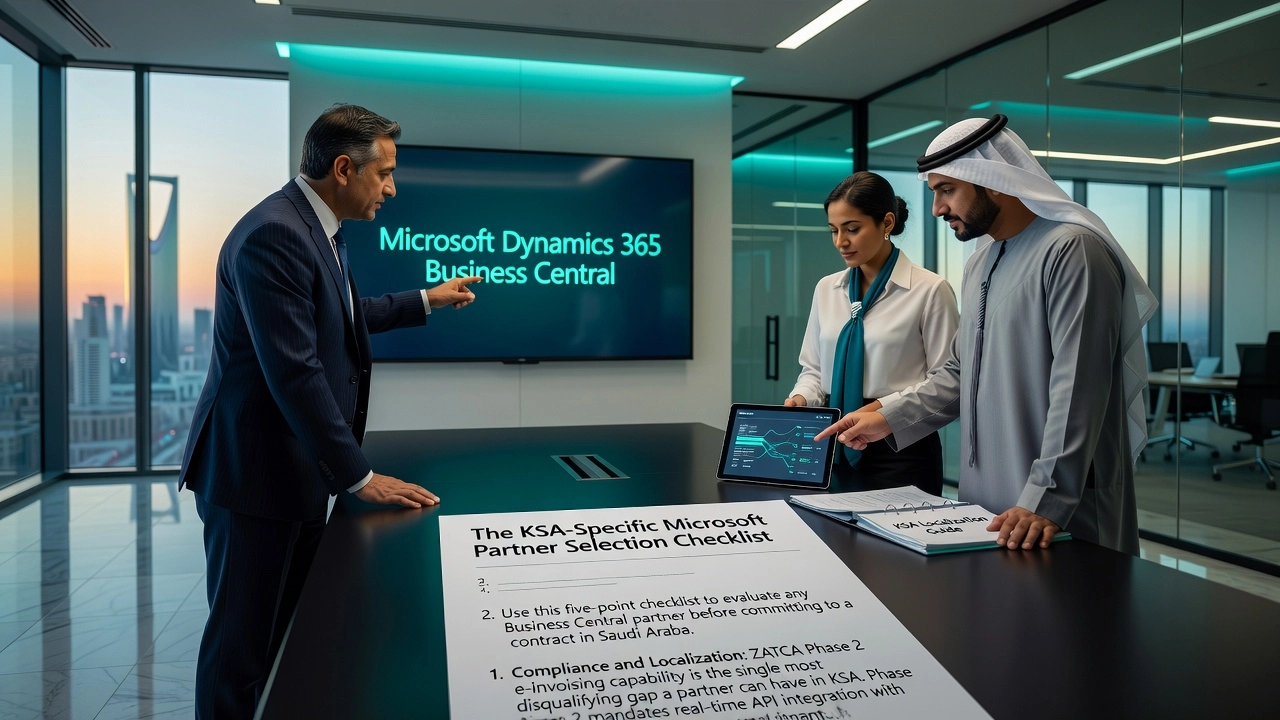
The KSA-Specific Microsoft Partner Selection Checklist
Use this five-point checklist to evaluate any Business Central partner before committing to a contract in Saudi Arabia.
1. Compliance and Localization
ZATCA Phase 2 e-invoicing capability is the single most disqualifying gap a partner can have in KSA. Phase 2 mandates real-time API integration with ZATCA's Fatoora portal, with B2B invoices requiring clearance before delivery to clients and B2C invoices requiring reporting within 24 hours of issuance. Invoices must be generated in UBL 2.1 XML format, embedded in PDF/A-3 files, and include digital signatures, UUIDs, and QR codes. A partner who cannot demonstrate a live, tested implementation against current wave requirements is a material compliance risk. Beyond e-invoicing, verify Arabic-language interface support, Hijri calendar configuration, and local VAT, payroll, and HR compliance within Business Central. These are KSA-specific requirements that regional or generalist partners frequently under-deliver on, and their absence should disqualify a partner immediately. For a technical overview of Saudi Arabia e-invoicing requirements within Dynamics 365, Microsoft's official documentation is the authoritative reference point.
2. References and Track Record
Request references exclusively from Saudi businesses. UAE, Bahrain, or global case studies do not validate KSA compliance experience, as ZATCA Phase 2 API integration is a fundamentally different challenge from Phase 1 generation. Ask specifically how many Business Central go-lives the partner has completed in KSA, under which ZATCA wave each client was onboarded, and whether any references operate in your industry vertical. A partner with strong retail references but no manufacturing go-lives in KSA is not the right fit for a manufacturing business.
3. Technical Capability
Confirm the partner can configure and activate Microsoft Copilot and AI features introduced in the 2026 Release Wave 1, which embeds agentic AI into purchase and sales workflows across Business Central. Power Platform automation should be standard delivery, not an add-on. Also ask for the partner's documented approach to minimizing unnecessary customization. This is a reliable indicator of implementation discipline; partners who customize first and configure second consistently produce higher-risk, harder-to-maintain deployments. For additional context on ZATCA integration technical requirements within Business Central, the technical depth required extends to API authentication, UUID generation, and automated error handling.
4. Support and Communication
Verify that Arabic-speaking consultants and project managers are available throughout the engagement, not only during pre-sales. Confirm that support hours align with KSA business hours (Sunday through Thursday) and ask for a written description of the post-go-live support model before signing. Given that a failed ZATCA clearance means an invoice cannot legally be sent to a client, support response times for compliance-critical incidents are a commercial requirement, not a soft preference.
5. Commercial and Process Rigor
Require a detailed RFP response that includes a clear implementation methodology, project timeline, resource allocation plan, and transparent pricing structure. Partners who cannot produce this level of documentation are signaling limited delivery maturity. Clarify whether pricing is fixed-fee or time-and-materials, as each model carries different risk implications for the buyer. Also confirm that the partner's contract covers ongoing ZATCA compliance maintenance, given that new business cohorts continue to be onboarded through 2026 and regulatory updates may follow.
Red Flags to Watch for When Evaluating Microsoft Partners in KSA
Knowing what to look for in a strong partner is only half the evaluation. Knowing what to walk away from is equally important. These five warning signs consistently appear in underqualified or misaligned partner engagements across the KSA market.
1. References drawn entirely from outside Saudi Arabia A partner presenting case studies exclusively from European, North American, or even broader GCC markets cannot demonstrate genuine in-Kingdom implementation experience. KSA deployments involve specific regulatory, linguistic, and operational variables that do not transfer from other markets. If a partner describes a strong "regional presence" but cannot produce documented Saudi client outcomes, treat that gap as a structural credibility issue, not a minor detail.
2. Award logos leading the conversation instead of delivery evidence Certifications and Microsoft Solutions Partner designations are threshold qualifications, not performance guarantees. A partner who opens with badges rather than implementation methodology, project governance frameworks, and measurable post-go-live results is substituting marketing for evidence.
3. No proactive mention of ZATCA compliance Any experienced KSA Microsoft partner will raise ZATCA e-invoicing compliance unprompted in a first discovery conversation. Silence on this point signals either limited in-Kingdom experience or an intent to surface compliance requirements later as billable scope additions.
4. Heavy customization promised before your processes are understood Per executive guidance on partner selection in Saudi Arabia, unnecessary customization is a primary driver of ERP failure and cost overrun. Partners who position customization volume as a capability signal have the logic inverted.
5. No in-region presence, no Arabic-speaking staff Consulting teams operating entirely outside KSA introduce time-zone delays, communication friction, and post-go-live support gaps that compound throughout the implementation lifecycle.
Choosing the Right Microsoft Partner in Saudi Arabia
The right Microsoft Dynamics 365 partner in Saudi Arabia is not identified by where they rank in a search result or how many awards appear on their website. The genuine differentiators are a documented local implementation track record, verifiable ZATCA compliance expertise, Arabic localization capability, and a delivery methodology built around measurable business outcomes. These are the criteria that determine whether your ERP project succeeds or stalls.
Before entering any formal RFP process, use the KSA-specific checklist covered earlier in this guide to qualify candidates at the discovery stage. That first conversation reveals more than any proposal document; a capable partner should respond to your requirements with clarity, a defined methodology, and relevant local references from the opening meeting.
Index of Solutions has been delivering Microsoft Dynamics 365 Business Central implementations across Saudi Arabia and the broader Middle East, supporting SMEs and mid-market businesses in retail, trading, manufacturing, and fashion. The focus is on helping organizations move from legacy or underperforming systems onto a scalable, compliant platform that reflects how their business actually operates.
Bring your current system pain points, your operational requirements, and your go-live timeline. Understanding how Microsoft partners in Saudi Arabia drive digital transformation starts with that direct conversation, where a qualified partner demonstrates both technical depth and genuine regional knowledge.
Conclusion
Choosing the right Microsoft Dynamics 365 partner in Saudi Arabia is not a decision to rush. The partners that stand out share three qualities: verified certifications backed by real project experience, deep knowledge of local regulatory and business environments, and a proven ability to deliver measurable results after go-live.
Vision 2030 is not slowing down, and neither is the pressure to modernize. The businesses that move forward with the right implementation partner will gain a competitive edge that compounds over time.
Your next step is simple. Shortlist two or three partners from this guide, request case studies relevant to your industry, and schedule discovery calls before committing. The right partner will ask the right questions from day one.
Your digital transformation is too important to leave to chance. Choose wisely, act confidently, and build for the future Saudi Arabia is already creating.