HR Software in Lebanon 2026: What Actually Works for Lebanese Companies
Written by Youssef Nasser
HR software in Lebanon is a topic most companies either ignore until they're overwhelmed by headcount, or invest in the wrong system and regret it. The challenges are real and specific to Lebanon: multi-currency payroll (USD and LBP), NSSF compliance, frequent regulatory changes, and a workforce that often spans different contract types, locations, and seniority structures.
This guide covers what HR software actually needs to do for a Lebanese company in 2026, what options exist, and what to look for before you commit.
The Lebanese HR Challenge
Before evaluating software, it helps to understand why generic HR platforms often fail in Lebanon:
1. Multi-currency payroll
Lebanon's dual-currency reality means many companies pay in a combination of USD and LBP — sometimes at different rates for different employee tiers. A standard HR system built for single-currency markets handles this poorly or not at all.
2. NSSF compliance
The National Social Security Fund has specific contribution calculations, end-of-service indemnity rules, and reporting requirements. Software that does not have Lebanese NSSF logic built in forces your HR team to do parallel calculations in spreadsheets — defeating the purpose.
3. End-of-service calculations
Lebanese labour law mandates specific end-of-service indemnity calculations. These need to be tracked per employee from their start date, with correct rates applied per seniority tier.
4. Variable contract types
Lebanese companies often employ a mix of full-time, part-time, contract, and commission-based staff — sometimes across multiple entities. A system that handles only one contract type creates gaps.
5. Arabic reporting
Government forms, NSSF submissions, and employee documents need to be produced in Arabic. International HR platforms often lack this capability without expensive localisation.
What Lebanese HR Software Actually Needs to Do
Core Payroll
- › Gross-to-net in USD and LBP with mixed exchange rate rules
- › NSSF employer and employee contributions
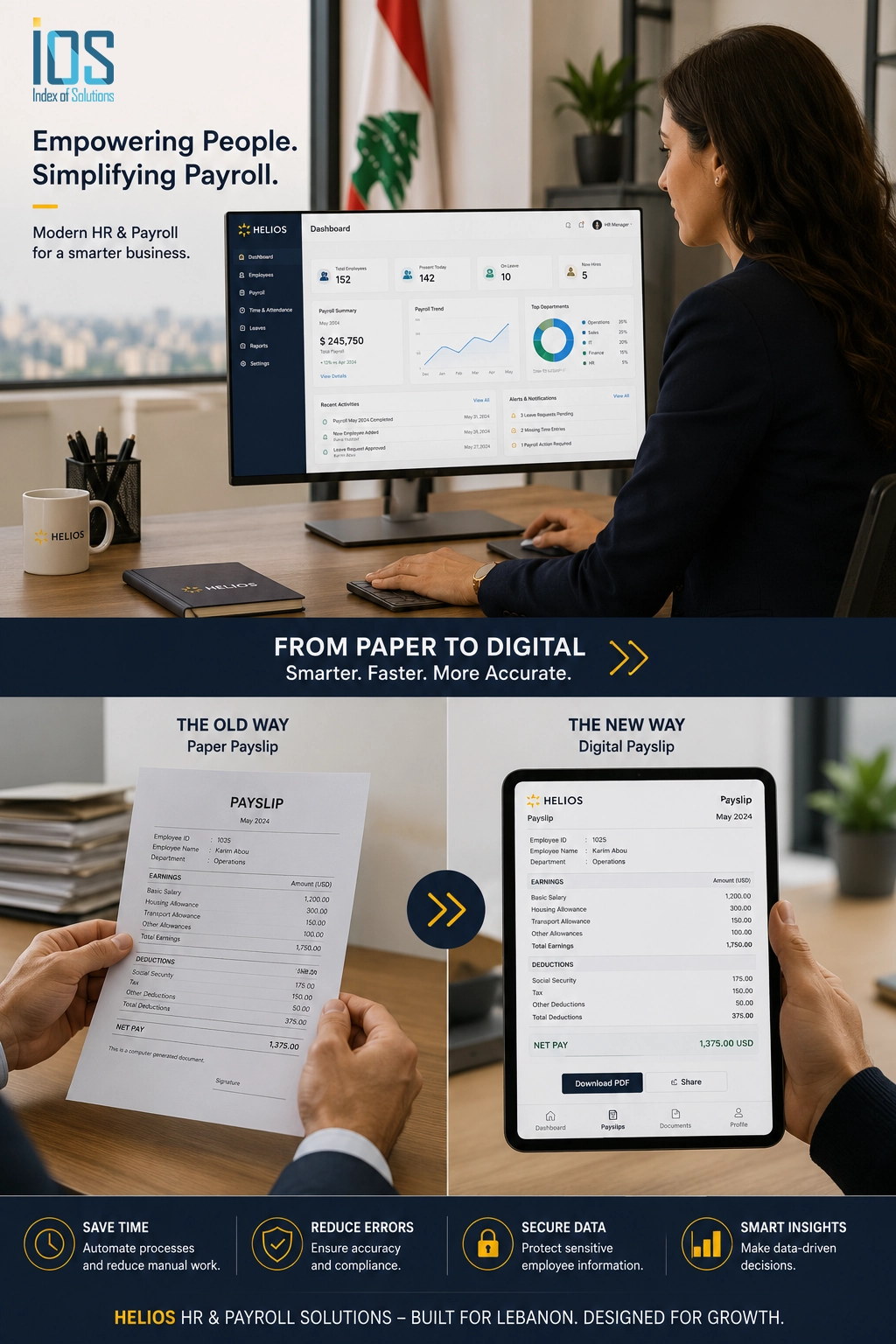
- › Payslips in Arabic and English
- › End-of-service indemnity accrual and payout
Employee Records
- › Full lifecycle: onboarding, transfers, promotions, terminations
- › Documents with expiry alerts (visas, passports, contracts)
- › Org chart and reporting structure
Leave Management
- › Lebanese labour law entitlements
- › Balance tracking with carry-over rules
- › Manager approval workflows
Reporting & Compliance
- › NSSF contribution reports in required format
- › Ministry of Finance tax reports
- › Custom reports exportable to Excel or PDF
HR Software Options for Lebanese Businesses
Full-Stack HR Platform + Business Central
An HR platform built on the Microsoft ecosystem, integrated natively with Business Central's financial module. Payroll postings flow directly to the general ledger, employee costs are visible per department, and HR decisions are grounded in real financial data.
Standalone Lebanese HR Software
Several Lebanese vendors offer standalone HR and payroll tools — often more affordable upfront with local compliance built in, but no ERP integration. Finance and HR live in separate systems.
Best for: Small companies under 30 employees that don't yet run a full ERP. Limitation: Manual journal entries required; limited scalability.
International Platforms (Workday, SAP SuccessFactors, Zoho People)
Global platforms with strong feature sets but lacking Lebanese-specific compliance out of the box. Localisation requires extra cost and depends on the vendor's commitment to maintaining Lebanese rules.
Best for: Large multinationals where HQ has standardised on a global platform. Limitation: High cost; NSSF customisation required; often overkill for SMBs.
What to Ask Any HR Software Vendor
Before signing anything, get answers to these questions:
Does your system calculate NSSF contributions and end-of-service indemnity natively? Ask for a live demo, not a yes/no answer.
Can payroll be processed in both USD and LBP, with different rates per employee?
Does the system generate Arabic payslips and NSSF reports in the required format?
How does payroll integrate with your accounting system? Manual export? API? Native integration?
How do you handle regulatory changes? When NSSF rules change, how quickly is the system updated?
What does the implementation timeline look like? A good implementation includes a parallel payroll run before going live.
The Cost of Not Getting HR Right
Lebanese HR directors consistently underestimate the cost of poor HR software. The real costs go beyond re-processing payroll:
NSSF Penalties
Incorrect contributions or late submissions trigger fines that compound over time.
Employee Trust
Payslip errors or delayed payments damage morale and retention.
Finance Reconciliation
Mismatched HR and accounting systems mean hours of manual reconciliation every month.
Delayed Decisions
HR data locked in spreadsheets nobody trusts slows down headcount and cost decisions.
A well-implemented HR system with correct Lebanese logic pays for itself within 6–12 months through time savings alone.
Conclusion
HR software in Lebanon is not a solved problem — but the right solution does exist. The key is finding software that handles Lebanese compliance natively, integrates with your financial system, and can scale as your headcount grows.
If you are already on Business Central — or considering it — an integrated Full Stack HR Platform that shares the same data model as your ERP is almost always the right choice. It eliminates the integration layer that creates errors, gives your finance team real-time visibility into HR costs, and ensures payroll compliance without manual workarounds.
Want to see how our Full Stack HR Platform works with Business Central?
Contact our team for a demo tailored to your company's size and payroll structure.
Index of Solutions is a Microsoft Certified ERP and HR solutions partner based in Beirut, Lebanon. We implement and support HR and payroll systems for companies across Lebanon and the region.